.webp)







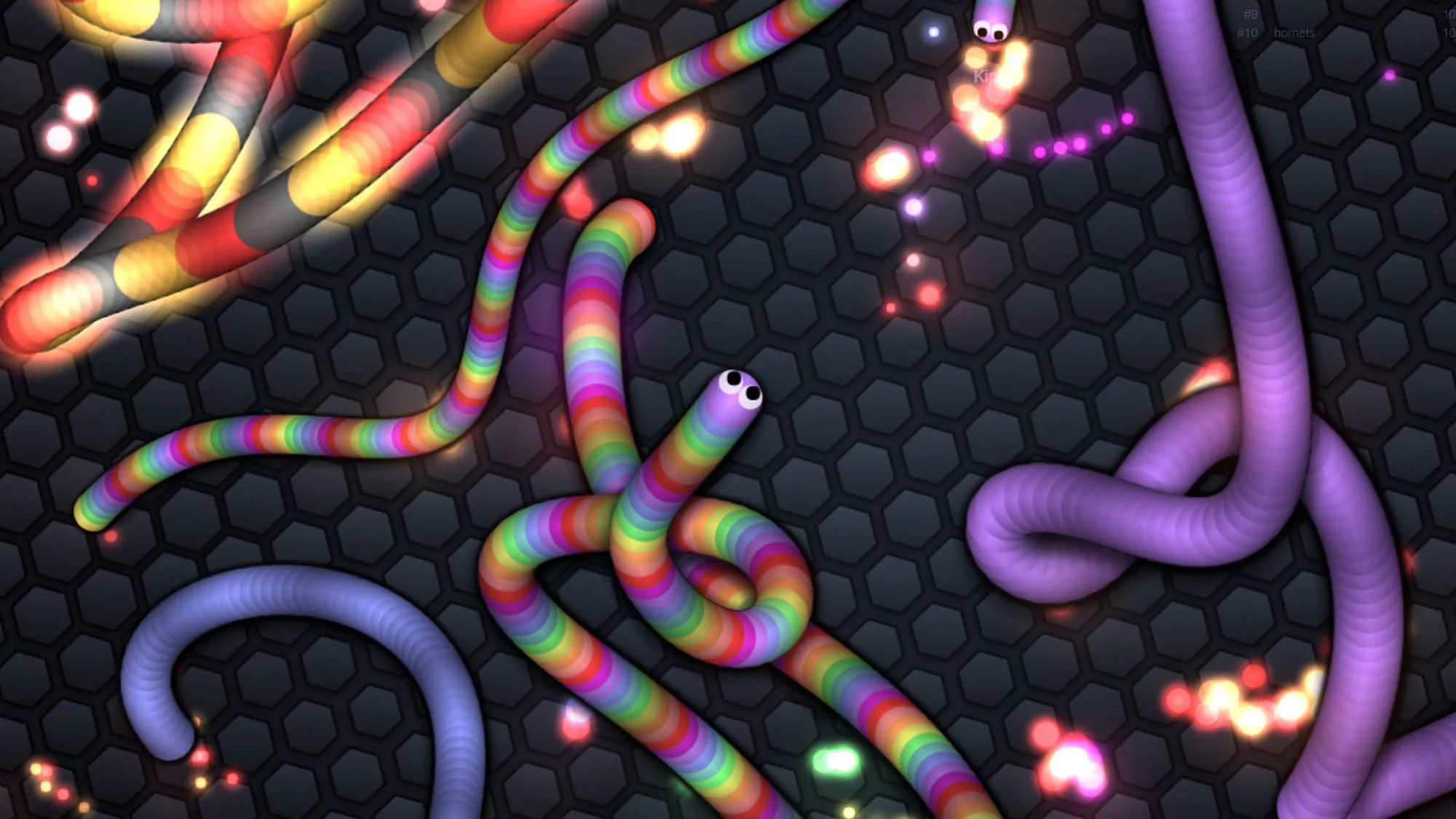
The viral explosion of Slither.io marked a critical moment in browser game history. It evolved the structural foundations of Agar.io by introducing a highly complex geometric variable: snake body mechanics.
Unlike classic grid-locked titles, Slither.io operates within a continuous 2D plane governed by momentum-based friction. The title’s core achievement lies in its absolute democratization of lethality. A microscopic snake can effortlessly destroy a massive leviathan through precise spatial cutting.
However, beneath this accessible arcade exterior lies a profound mechanical tragedy regarding structural scaling. As a player consolidates mass, the game mechanics silently alter the underlying physics engine. This system decreases turn-radius velocity and increases structural mass inertia.
The hidden relationships between snake length, body lag, and server latency turn a giant snake into a self-defeating prison. Instead of rewarding long-term survival, the physics engine creates an unavoidable trap where the laws of momentum guarantee your inevitable destruction.
The mechanical lifecycle of every snake begins in the vast, outer peripheral zones of the arena. The player materializes as a low-mass entity with a default length value.
In these initial moments, the game functions as a pure test of micro-spatial precision. Your snake offers unmatched mechanical agility. The turn radius is extremely tight, allowing for instantaneous 180-degree directional changes executed within a handful of frame cycles.
This extreme maneuverability allows small snakes to navigate dense clusters of glowing mass safely. You can rapidly slip through small gaps between mid-sized competitors without risk of collision.
During this early phase, the physics engine uses a highly responsive, low-inertia vector calculation. The body segments follow the head's exact path with minimal structural lag, creating a predictable line of movement.
The player can easily farm the small, passively spawning glowing particles scattered across the map. This allows you to build your mass index without attracting the attention of aggressive predators.
The mechanical loop rewards high spatial awareness and rapid reflex inputs. It reinforces a fundamental truth: at low sizes, your small mass is your greatest tactical asset.
The transition to an active predator occurs when the snake crosses the threshold of approximately 500 mass units. At this size, the player acquires enough structural length to execute basic combat maneuvers like the coil trap.
However, this increase in mass triggers an automatic adjustment within the game's internal physics equations. The turning radius begins to expand, and the body segments display a noticeable delay in following the head's precise path. This marks the end of perfect agility.
As a snake approaches a mass value of 5,000, the relationship between length and rotational speed becomes your primary obstacle. The game’s hidden physics engine is programmed to scale the maximum angular velocity inversely against total volume.
This design choice prevents massive snakes from spinning like chaotic buzzsaws across the arena, which would completely ruin the balance for smaller players. However, it severely limits the giant's defensive capabilities.
The Hidden Penalty on Turning Velocity
This mechanical dampening is applied gradually through three distinct operational phases as your snake scales:
- The Linear Phase: Turn radius remains highly responsive, scaling smoothly alongside early food collection.
- The Transitional Inflexion: Body lag introduces a noticeable delay, causing the tail to swing outward during sharp turns.
- The Logarithmic Lock: Turning performance hits a strict cap, rendering the snake incapable of executing quick defensive pivots.
This systematic widening of the turn radius completely alters how the player must approach positioning. A sharp pivot that previously required a fraction of a second now demands a sweeping, predictable arc.
This mechanical limitation exposes the snake’s vulnerable side flanks to nearby opponents. Small, agile predators can easily spot these slow, sweeping movements and dive directly into the path of the turning giant.
The physics engine forces the large player into a highly defensive, predictive mindset. You can no longer react to immediate, close-quarters threats in real time.
The primary active mechanic in Slither.io is the speed boost. This is triggered by holding down the mouse button to rapidly accelerate your movement velocity.
This mechanic serves as the core offensive tool for executing sudden cuts, bypassing enemy positions, or escaping dangerous situations. However, this mobility comes at a steep economic price: activating the boost causes the snake to continuously shed its internal mass.
The Dynamics of Boost-Induced Starvation
For a small snake, the absolute mass lost during a short acceleration sprint is practically negligible. This makes the boost an easily spammable tool for aggressive hunting.
However, the mass-drain equation scales exponentially based on the snake's total volume. When a leviathan with 20,000 mass activates their boost, the volume of mass expelled per second is massive.
This quickly turns a tactical sprint into a highly wasteful, self-destructive action. The particles dropped behind a boosting giant can instantly supercharge a swarm of small scavenger snakes.
This creates a brutal mechanical dilemma for high-ranking players. To protect their massive body from small attackers, they frequently need to boost to cut off incoming threats.
Yet, the act of boosting actively drains their score and feeds the very predators hunting them down. If a giant player panics and boosts for too long, they can easily drop thousands of mass points in a matter of seconds, effectively starving their own score.
Once a snake achieves a length metric that allows it to safely encircle smaller opponents, the gameplay loop shifts toward the Coil Trap. This tactical maneuver requires the player to form a closed geometric circle around a target snake.
This action completely cuts off their escape routes and traps them inside an inescapable wall of death. As the circle gradually tightens, the trapped player is eventually forced to collide with the giant snake's inner body, transforming into high-value mass.
While the coil trap is an incredibly reliable method for securing food, executing it introduces significant structural risks. The moment a player closes a circle around a victim, their own movement path becomes locked into a highly predictable circular orbit.
Smaller, opportunistic snakes outside the coil can easily recognize this locked path. They will quickly form a secondary, defensive perimeter around the giant snake's outer body.
The Nesting Doll Failure State
This creates a terrifying nesting doll effect where the hunter instantly becomes the hunted. The giant snake, focused entirely on slowly crushing the victim inside its inner coil, is completely blind to outer threats.
An aggressive opponent can easily wrap around the giant's own outer flank. The rigid geometric constraints of maintaining a closed coil make it impossible for the giant to pivot defensively without breaking the loop and releasing their trapped food.
The most destructive force acting against high-mass players is the hidden relationship between snake length and server-side tick-rate lag. The game operates on a client-server architecture where the position of every single body segment must be synced in real time.
For a microscopic snake consisting of ten segments, this data footprint is incredibly small. This results in near-perfect hit-registration and crisp responsive movement.
However, when a player successfully scales to a massive size, their snake consists of thousands of interconnected physics segments. The server must constantly process the vector collision math for every single one of these segments against every other snake head in the area.
This localized data overload creates a profound mechanical phenomenon known as Body Lag. The visual representation of the snake's tail segments on your screen drifts dangerously out of sync with the actual logic calculated by the server.
The Breakdown of Spatial Synchronicity
When server latency spikes, the structural integrity of a large snake's hitboxes collapses entirely, creating a highly volatile playground for smaller opponents:
- Visual Desynchronization: The client screen displays a smooth, curved defensive line while the server registers a jagged, delayed path.
- Ghost Collisions: Small snakes unexpectedly phase directly through outer body segments, striking the head hitbox due to server position updates.
- Input Failure States: Emergency mouse inputs fail to register within the required tick window, turning a tight defensive turn into an accidental head-on crash.
This computational lag hits giant snakes with extreme prejudice. A small snake can make an unexpected, erratic movement and instantly benefit from client-side interpolation, appearing to teleport slightly ahead of their actual path.
If a giant snake tries to respond to this lag-assisted dive with a defensive maneuver, the server-side lag on their massive body segments often guarantees a collision. The physics engine essentially punishes long-term survival by turning computational latency into a lethal weapon wielded against the largest entities.
The spatial geography of the Slither.io arena is entirely open, devoid of any physical walls, obstacles, or safe zones. However, the map naturally develops a highly dangerous sociological epicenter known as the Central Core.
This region acts as a high-density slaughterhouse, drawing in a non-stop stream of players due to the constant accumulation of glowing mass generated by continuous player deaths.
For a small snake, diving into the chaotic mess of the Central Core is a highly rewarding, low-risk gamble. Since they have no substantial mass to lose upon death, they can recklessly boost through the meat grinder.
They vacuum up thousands of dropped particles from fallen giants within a matter of seconds. If they crash and die, they can simply respawn instantly and try again, making the core an efficient engine for rapid power-leveling.
For a high-mass giant, entering the Central Core is absolute tactical suicide. Because their massive length requires an immense amount of physical space to turn and defend, the hyper-dense crowd conditions eliminate their ability to navigate safely.
The giant is instantly surrounded by dozens of hyper-aggressive, low-mass players who have absolutely nothing to lose. The massive gravitational pull of the center’s endless food supply lures in giants, only to trap them in a chaotic space where their superior size becomes an inescapable target.
When a massive player realizes that the mechanical odds are heavily stacked against them, they typically retreat to the quiet outer edges of the map. There, they adopt a permanent defensive strategy known as the Endless Defensive Circle.
This tactic is the ultimate manifestation of survival-focused gameplay. The giant snake simply crosses its own head over its tail segment, locking itself into a permanent, spinning defensive loop that cannot be penetrated by outside players.
Because any opponent who tries to dive into the spinning circle will inevitably crash into the giant's invulnerable outer body segments, this loop creates a perfect defensive shield. The giant can sit in this locked formation indefinitely, safely protected from the chaotic skill of other players.
However, while this strategy guarantees short-term safety, it represents a complete breakdown of engaging gameplay and introduces a slow, systemic economic decline.
The Passive Decay Bottleneck
The primary mechanical issue with the endless defensive circle is that it completely freezes the player's ability to gather new food resources:
- Resource Isolation: The giant is locked into a fixed spatial path and cannot move to collect passively spawning particles or hunt down other players.
- Mass Degradation: The game's internal mechanics continue to apply a passive, long-term mass decay value to large snakes, slowly chipping away at their total score over time.
The endless circle transforms the game into a slow-motion countdown toward irrelevance. It forces the player to choose between an un-engaging turtle strategy or an incredibly risky return to active combat.
The moment a snake crosses the legendary 30,000 mass threshold, its presence on the server shifts from a standard competitor to a highly prized global event.
Smaller players will actively abandon their local farming zones to form loose, cooperative Scavenger Swarms that follow the leviathan across the map like pilot fish swimming alongside a massive whale. This relationship is entirely cannibalistic; the swarm waits patiently for the exact moment the giant makes a single mechanical miscalculation.
The scavenger swarm utilizes a highly effective tactical doctrine based on continuous psychological harassment and space restriction. Individual small snakes will take turns launching aggressive, high-speed boosting runs directly at the giant’s head hitbox, forcing the large player to continuously execute wide, awkward defensive turns.
Even if these attacking snakes miss and explode into food particles, the giant often cannot safely pivot to consume them without exposing their vulnerable flanks to the rest of the waiting swarm.
The Anatomy of Swarm Harassment
The collective behavior of the scavenger swarm systematically strips the high-mass player of all operational control through coordinated environmental pressure:
The Lead Cutter: Fast, low-mass snakes sacrifice themselves in high-speed head-on dives to force defensive panic.
The Flank Flattener: Mid-sized scavengers run tightly parallel to the giant's outer body, preventing them from opening up their turn radius.
The Cleanup Crew: Micro-snakes sit behind the combat line, instantly eating any dropped particles to ensure the giant gains no health from the encounters.
This continuous tactical pressure creates a massive psychological burden for the giant player. You are forced to play with absolute perfection for tens of minutes at a time, while the swarm only needs to succeed once to claim their massive prize.
The endless waves of suicidal attacks eventually cause mental exhaustion, leading the giant to make an accidental over-correction or a fatal lag-induced misclick that instantly ends their long-term empire.
The ultimate mechanical failure state for a mega-mass player occurs when the sheer length of their own snake body becomes their primary tactical hazard. This phenomenon is known as Self-Intersecting Constriction.
As a snake grows to extreme lengths, the physical trail of its own body segments can stretch across multiple screens of data. When trying to navigate away from an approaching wall or a rival giant, the player is frequently forced to pivot back and forth through their own loops, creating a highly complex maze of their own making.
This self-created maze introduces a massive geometric hazard. If an aggressive opponent manages to position themselves tightly alongside the giant's head while the giant is navigating through their own body loops, the giant can easily find themselves completely boxed in.
The player is caught in a tight, self-destructive vice where every available path leads directly to a lethal crash.
This mechanical bottleneck represents the peak of Slither.io's architectural irony. The very mass and length that the player spent hours carefully accumulating transforms into the literal wall that seals their execution.
The player cannot blame an unfair mechanic or an overpowered item; they are destroyed by the physical scale of their own success, proving that in this arena, infinite growth is structurally incompatible with long-term survival.
When a massive leviathan inevitably crashes and explodes, the immediate mechanical consequences on the surrounding server environment are genuinely spectacular.
The sudden release of 50,000 mass units into a localized sector of the map creates an immediate, gold-rush frenzy. Hundreds of nearby snakes dive headfirst into the remains to vacuum up the massive bounty.
The screen transforms into a chaotic explosion of bright, hyper-dense light particles, triggering massive framerate drops and widespread panic as players murder each other in a desperate scramble to secure a share of the spoils.
This massive explosion of resources serves a vital systemic function, acting as the primary engine for server-side wealth redistribution and lifecycle renewal. Within a matter of seconds, the fallen giant's consolidated mass is broken down and absorbed by dozens of small, low-tier players.
This instantly catapultes multiple micro-snakes into the mid-to-high tiers of the leaderboard. The server's economic landscape is completely rebalanced, clearing out old, defensive giants to make room for a new generation of agile, highly aggressive competitors.
For the player who died, this moment offers a unique form of mechanical closure. The heavy, stressful burdens of mass inertia, wide turn radiuses, and crushing server lag are instantly wiped away.
They are replaced by the crisp responsiveness and total tactical freedom of a newly spawned entity. The player is reminded that the true joy of Slither.io is not found in the boring, defensive maintenance of a massive score, but in the fast-paced, high-stakes agility of the hunt itself.